Eliminating the Permission to Forget Through Continuous Learning Systems
Presented by:
Cortni Krusemark, Augustana University
Keywords:
Continuous Improvement, Competency-Based Education, Hybrid Learning
Hear it from the author:
Transcript:
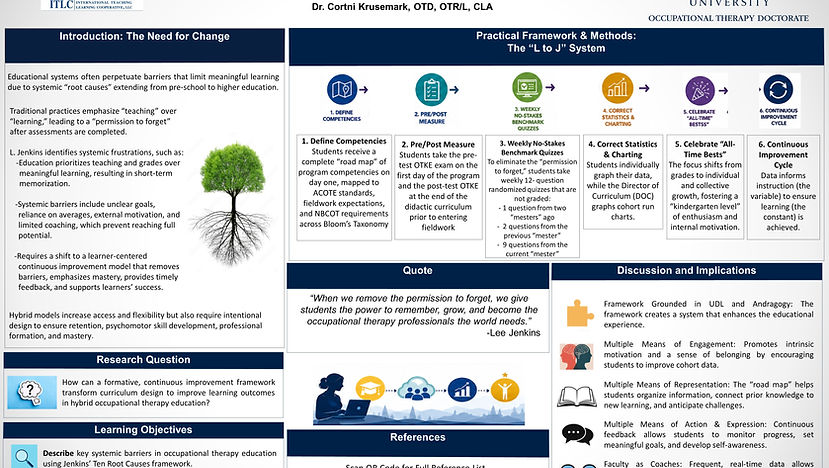
Thanks for stopping by! I’m Dr. Cortni Krusemark, Director of Curriculum at Augustana University in the Occupational Therapy Doctorate program. This poster explores how implementing a continuous improvement framework can eliminate what Lee Jenkins calls the 'permission to forget' in hybrid occupational therapy education. Traditional education often rewards short-term memorization for exams, but our goal is to create lasting competency and professional readiness.
We designed our hybrid OTD curriculum using Jenkins' Continuous Improvement principles and Universal Design for Learning. Students receive a clear competency roadmap from day one, complete weekly no-stakes cumulative quizzes, graph their own progress over time, and celebrate personal and cohort growth rather than focusing solely on grades. Faculty use this real-time data to coach students, assess curricular strengths and gaps, and adjust instruction before learning gaps become barriers.
The result is a shift from teaching to learning—promoting retrieval practice, intrinsic motivation, a sense of belonging, and continuous improvement for both the students and the program. We believe this approach better prepares students for fieldwork, the NBCOT exam, and ultimately clinical practice by ensuring they retain and apply knowledge rather than simply memorizing it for the next test. I'd love to hear your thoughts or answer any questions about how this model could work in your own program.
Key Statement:
An innovative OTD curriculum model applies continuous improvement principles, competency mapping, and hybrid design to eliminate systemic barriers and promote meaningful, sustained student learning.
Abstract:
Educational systems often perpetuate barriers that limit meaningful learning, as described in Lee Jenkins’ “Ten Root Causes of America’s Frustration With Education.” These challenges extend into higher education, where misalignment, unclear competencies, and outdated assessment practices hinder student success. This project presents an accelerated hybrid Occupational Therapy Doctorate (OTD) curriculum grounded in continuous improvement and Universal Design for Learning. The model emphasizes competency mapping, spaced retrieval, real-time feedback, and andragogical principles to prioritize learning over teaching. By restructuring assessment and instructional design, this approach fosters deeper understanding, student motivation, and confidence, preparing graduates for success on their certification exam and in professional practice.
Outcomes:
1. Describe key systemic barriers in occupational therapy education using Jenkins’ Ten Root Causes framework.
2. Explain how continuous improvement principles and UDL can be applied to redesign curriculum and assessment practices.
3. Examine the impact of competency-based, hybrid educational models on student learning, motivation, and professional readiness.
References:
Batt, A., Williams, B., Rich, J., & Tavares, W. (2021). A six-step model for developing competency frameworks in the healthcare professions. Frontiers in Medicine, 8, 789518. https://doi.org/10.3389/fmed.2021.789518
Gagnon, K., Young, B., Bachman, T., Longbottom, T., Severin, R., & Walker, M. J. (2020). Doctor of physical therapy education in a hybrid learning environment: Reimagining the possibilities and navigating a “new normal.” Physical Therapy, 100(8), 1268–1277. https://doi.org/10.1093/ptj/pzaa096
Jenkins, L. (2004). Permission to forget: And nine other root causes of America’s frustration with education. Learning Options.
Kohler-Evans, P., Rutledge, C. D., & Barnes, C. D. (2019). Universal design for learning in the university classroom. International Research in Higher Education, 4(1), 38–47. https://doi.org/10.5430/irhe.v4n1p38